In a world where everything seems to be getting faster and more digital, 3D printing stands out as the quirky cousin at the family reunion. Imagine turning a wild idea into a tangible object right before your eyes—no magic wands required! This revolutionary technology is transforming industries from healthcare to aerospace, making it possible to create everything from custom prosthetics to rocket parts.
What Is D Printing?
D printing, commonly known as 3D printing, involves creating three-dimensional objects from digital files. This process builds items layer by layer, allowing for complex shapes and designs. Industries such as healthcare and aerospace utilize D printing for its ability to produce specialized parts efficiently.
In healthcare, D printing facilitates the creation of custom prosthetics tailored to individual patient needs. These prosthetics enhance comfort and functionality, improving quality of life for users. Additionally, it supports bioprinting, leading to advances in tissue engineering and regenerative medicine.
Aerospace benefits significantly from D printing as well. Manufacturers produce lightweight components that reduce overall aircraft weight, improving fuel efficiency. Complex geometries become feasible, resulting in stronger, more reliable parts.
D printing also has applications in architecture, where it helps create intricate models for visualizing projects. Architects use this technology to present designs to clients, allowing for realistic assessments before construction begins. Furthermore, educators incorporate D printing in schools, teaching students about design, engineering, and technology.
Businesses increasingly adopt D printing for prototyping. Rapid prototyping shortens the time required to develop new products, enabling companies to enter markets faster. These prototypes allow for testing and refining concepts before full-scale production.
Overall, D printing represents a groundbreaking shift in how products are designed and manufactured. By leveraging digital technologies, it streamlines production and fuels innovation across various sectors.
Types of D Printing Technologies
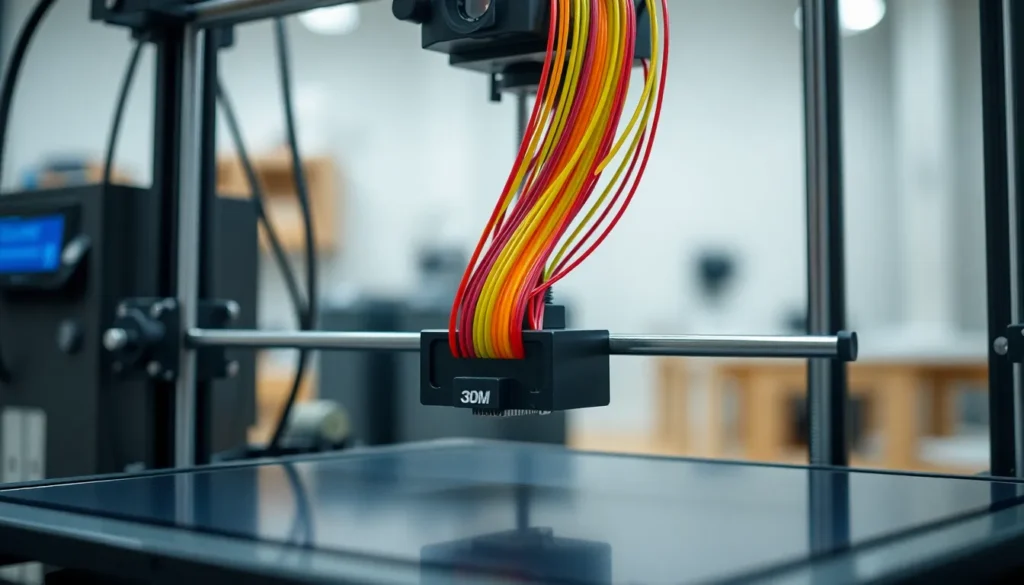
D printing encompasses a variety of technologies, each designed for specific applications and materials. Understanding these types enhances insights into the opportunities and capabilities of 3D printing.
Fused Deposition Modeling (FDM)
Fused Deposition Modeling (FDM) represents one of the most common 3D printing methods. It functions by heating thermoplastic filament until it melts and then extruding it layer by layer to create objects. This technique excels in producing durable prototypes and functional parts. Industries utilize it for manufacturing items ranging from consumer products to automotive components. Additionally, FDM printers are popular due to their accessibility and relatively low cost, making them ideal for both hobbyists and professionals alike.
Stereolithography (SLA)
Stereolithography (SLA) differs from FDM by using a liquid resin that cures under ultraviolet light. This process allows for incredibly precise and detailed prints. Many industries favor SLA for applications requiring high resolution, such as jewelry and dental models. The smooth finish of SLA prints often requires minimal post-processing, saving time and effort. Users appreciate how quickly SLA can produce complex geometries and intricate designs, enhancing its versatility.
Selective Laser Sintering (SLS)
Selective Laser Sintering (SLS) employs a laser to fuse powdered materials into solid objects. This technology effectively creates parts from various materials, including plastics and metals. Manufacturers value SLS for its capability to produce functional prototypes with strong mechanical properties. Complex designs and internal structures become feasible without the need for support materials. As a result, SLS serves multiple industries, including aerospace and automotive, where performance and durability matter most.
Applications of D Printing
D printing finds significant use across multiple sectors, enhancing design and production processes in innovative ways.
Prototyping
Rapid prototyping stands out as one of the most impactful applications of D printing. Designers create functional prototypes quickly, allowing for testing and refinement of concepts. Reduction in production time substantially decreases costs and fosters creativity. This method enables iterative design, where modifications occur based on feedback without needing extensive retooling. Industries rely on D printing for producing prototypes in various materials, ensuring precise detail aligns with final production needs. Shortening development timelines allows companies to bring products to market faster, maintaining a competitive edge.
Medical Uses
In healthcare, D printing revolutionizes the creation of custom medical devices. Surgeons utilize tailored prosthetics that enhance patient comfort and function. The technology enables the production of bioprinted tissues and organs for research and transplantation, offering innovative solutions to complex medical challenges. Its ability to replicate intricate anatomical structures allows for improved surgical planning and training. Additionally, dental applications benefit from D printing, as it produces accurate molds for crowns and aligners. Enhanced customization leads to better patient outcomes and satisfaction in medical treatments.
Aerospace and Automotive
D printing applies widely in aerospace and automotive industries, focusing on lightweight and durable components. Manufacturers implement this technology to produce parts with complex geometries that traditional methods struggle to achieve. Utilizing D printing results in stronger materials, contributing to improved fuel efficiency and performance. Additionally, the flexibility of design allows for rapid iteration of components during the development phase. Aerospace companies leverage these advantages for creating prototypes, leading to innovation in aircraft and spacecraft design. Automotive manufacturers also benefit from shorter production cycles, reducing costs while enhancing product performance.
Advantages and Disadvantages of D Printing
D printing offers several benefits and limitations that impact its adoption across industries. Understanding these factors helps evaluate its overall effectiveness.
Benefits
Cost efficiency emerges as a significant advantage. The rapid prototyping capabilities of D printing shorten production timelines and reduce material waste. Customization options are another highlight, allowing for the creation of one-of-a-kind products tailored to specific needs. Increased design freedom enables complex geometries that conventional manufacturing struggles to achieve. In fields like healthcare, producing bespoke prosthetics and medical devices addresses individual patient requirements, improving overall outcomes. Additionally, lightweight components produced in aerospace and automotive sectors enhance fuel efficiency without compromising strength.
Limitations
Despite its advantages, D printing has notable limitations. Material constraints sometimes restrict the types of materials available for printing, which can limit applications. Durability issues may arise with certain D printing techniques, necessitating further testing to ensure reliability. Speed also poses a challenge; while rapid prototyping is efficient, larger-scale production can be slower compared to traditional methods. Compliance with regulatory standards in industries like healthcare adds complexity, making it essential to validate the safety and efficacy of printed devices. These factors can hinder widespread adoption despite the technology’s potential.
The Future of D Printing
Innovative trends emerge in the landscape of D printing, showcasing its vast potential. Increasing advancements in materials lead to enhanced durability and performance, propelling industries toward greater efficiency. Customization options flourish, allowing manufacturers to produce unique components tailored to specific requirements.
Healthcare stands at the forefront of these developments. Bespoke prosthetics, created through D printing, significantly improve patient comfort and functionality. Tissue engineering gains traction, with bioprinting enabling the production of human tissues and organs for research and transplantation, streamlining surgical planning.
The aerospace sector also benefits from these advancements. Lightweight components crafted via D printing contribute to improved fuel efficiency and performance. Complex geometries that traditional manufacturing struggles to achieve become possible, allowing for a new wave of innovative products.
Prototyping capabilities evolve alongside the technology, enhancing rapid iteration capabilities. This ability to quickly design and test products translates into fewer production costs and improved time-to-market statistics. Enhanced collaboration among design and engineering teams further accelerates the innovation cycle.
Sustainability emerges as a key focus in future D printing endeavors. Research into eco-friendly materials strives to minimize environmental impact, catering to an increasingly eco-conscious consumer base. The industry prioritizes reducing waste through layer-by-layer construction, aligning with global sustainability trends.
Regulatory processes are under examination, too. As the technology matures, standardization efforts may emerge to address safety, quality, and compliance issues. Establishing guidelines that ensure reliable practices will promote broader adoption and trust in D printing across various sectors.
Ultimately, the future of D printing is a landscape rich with opportunity. By embracing innovation and sustainable practices, industries can maximize the benefits of this transformative technology.
The future of D printing is bright and full of potential. As industries continue to adopt this technology, its applications will expand and evolve. From healthcare to aerospace, D printing is reshaping how products are designed and manufactured.
Emphasizing sustainability and innovation will be crucial in maximizing its benefits. With ongoing advancements in materials and techniques, D printing is poised to revolutionize not just production processes but also everyday life.
As businesses and researchers push the boundaries of what’s possible, the opportunities for creativity and efficiency will only grow. The journey of D printing is just beginning, and its impact will undoubtedly be felt across multiple sectors for years to come.